
Nerve Honey Supplement Facts: The Full Label Transcript, the Math and What Is Missing
The panel exactly as the seller's label image prints it, checked line by line, with the gaps a buyer should ask about.
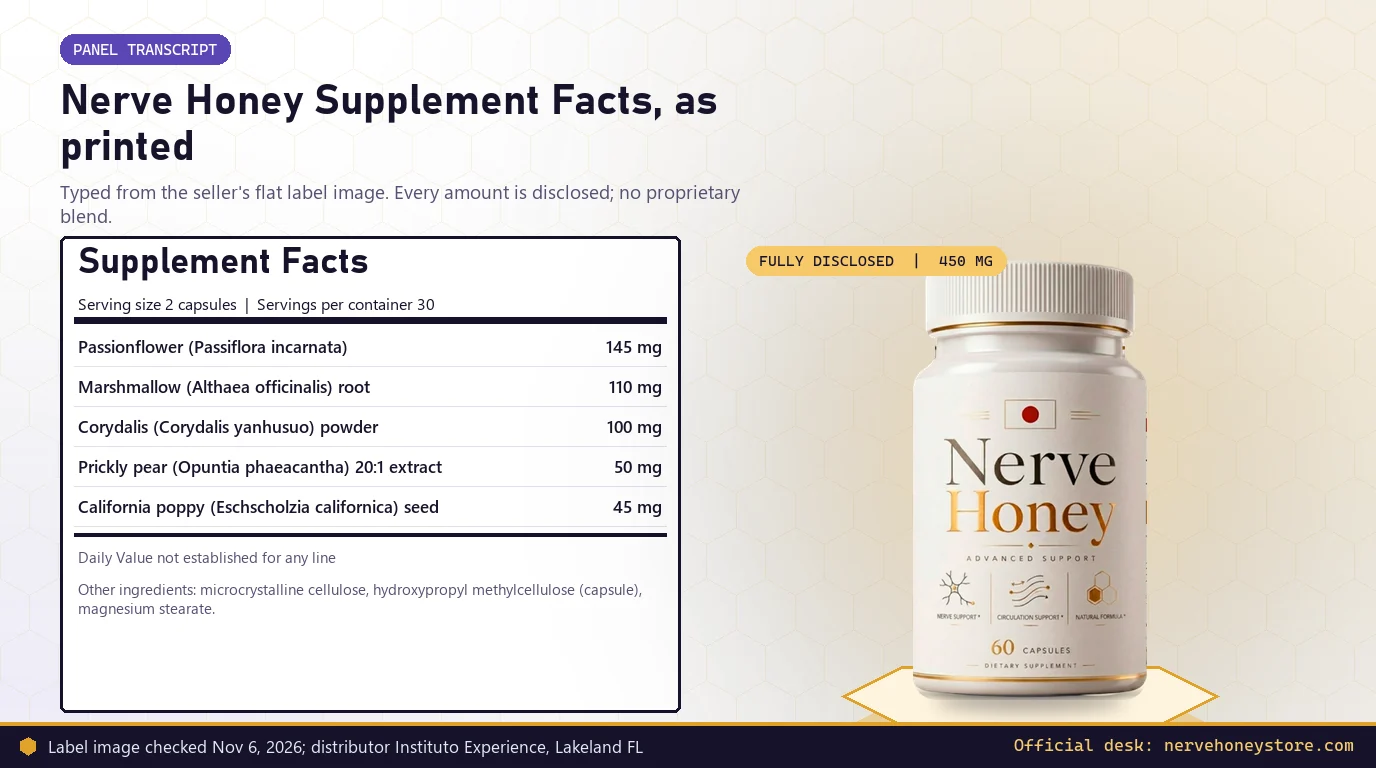
The panel, typed from the label
The seller publishes a flat, unrolled image of the full Nerve Honey bottle label on its own website. Two copies exist, uploaded in August 2026; their Supplement Facts panels are identical. We typed the panel below directly from that image. Wording is the label's, except that we spelled out the plant part in the order the label gives it.
Supplement Facts
Servings Per Container: 30
Other Ingredients: Microcrystalline Cellulose, Hydroxypropyl Methylcellulose (Capsule), Magnesium Stearate.
*These statements have not been evaluated by the Food and Drug Administration. This product is not intended to diagnose, treat, cure, or prevent any disease.
Label lines in full: Passionflower (Passiflora incarnata) 145 mg; Marshmallow (Althaea officinalis) Root 110 mg; Corydalis (Corydalis yanhusuo) Powder 100 mg; Prickly Pear (Opuntia phaeacantha) 20:1 Extract 50 mg; California Poppy (Eschscholzia californica) Seed 45 mg.
The rest of the back panel
Suggested use: "As a dietary supplement, take two (2) capsules daily with an 8 oz. glass of water."
Storage: "Keep away from heat, light, and humidity to preserve freshness." A second line repeats: "Store in a cool, dry place."
Caution: "Do not exceed recommended dose. Pregnant or nursing mothers, children under the age of 18 and individuals with a known medical condition should consult a physician before using this or any dietary supplement."
Warnings: "Keep out of the reach of children. Do not use if safety seal is damaged or missing."
Origin: "Made in the USA with globally sourced ingredients."
Distributor: Instituto Experience, Lakeland FL, 33804; +1 (507) 448-8190; [email protected].
Front of bottle: "Nerve Honey, Advanced Support," three icons (nerve support, circulation support, natural formula, each with an asterisk), "60 capsules, dietary supplement," and a small red-disc flag. No lot number, expiry date or barcode appears in the seller's images; check those on your own bottle.
Panel math, checked
| Check | Result |
|---|---|
| Sum of the five amounts | 145 + 110 + 100 + 50 + 45 = 450 mg per serving |
| Per capsule | 225 mg of herbs; the rest is cellulose filler and the shell |
| Servings vs. capsules | 30 servings x 2 capsules = 60 capsules, matching the bottle front |
| Days per bottle | 30 at the label serving |
| Order of lines | Descending by weight, as required |
| Daily Values | None established for any botanical, correctly marked with a dagger |
| Proprietary blend | None: every ingredient has its own amount |
Everything adds up. That is less common than it should be, and it is the strongest point in Nerve Honey's favor as a purchase: a buyer, pharmacist or doctor can see exactly what is in each serving.
What the panel does not tell you
Plant part on three lines
Federal labeling rules ask that each botanical be identified with the part of the plant used[1]. Marshmallow says root and California poppy says seed; passionflower, corydalis and prickly pear say nothing. For corydalis, the tuber is the only part used medicinally. For passionflower and prickly pear, the omission leaves real doubt.
Powder or extract, and to what strength
Only prickly pear is identified as an extract (20:1). Passionflower and corydalis could be raw ground plant or extracts; the label does not say, and the difference can be several-fold in potency. Corydalis is labeled "powder," which suggests raw ground tuber, not an alkaloid-standardized extract.
No standardization
None of the five lines states a marker compound (for example, flavonoids for passionflower or THP for corydalis). Without that, two batches could differ substantially and still match the label.
Who made it
"Made in the USA" with a Florida distributor, but no manufacturer is named, and the FDA's supplement pages explain that the agency does not vet products before sale [5]. Federal manufacturing rules require identity testing of every dietary ingredient and specifications for the finished product[3], but the records are not public.
Certificates of analysis: what would prove the panel
A certificate of analysis (CoA) is a lab report for a specific batch. For a product like Nerve Honey, a useful CoA would show: identity testing for each of the five plants (often by microscopy, thin-layer chromatography or DNA); assay results where a marker exists; heavy metals (lead, arsenic, cadmium, mercury); pesticide residues, which matter for imported botanicals; microbial counts (yeast, mold, E. coli, Salmonella); and the batch or lot number matching the bottle.
The seller does not publish any CoA, names no testing laboratory, and its sales page shows only generic emblems reading FDA, GMP and non-GMO. We do not present invented lab figures here. Corydalis has liver-injury reports [11], so identity is worth confirming: email the support desk with your lot number and ask for that batch's CoA before opening the bottle. A reputable seller can supply one; no answer is itself an answer.
Panel amounts next to research amounts
| Ingredient | Label | Research or traditional amount | Source |
|---|---|---|---|
| Passionflower | 145 mg | 500 mg extract before surgery; 260 mg before dental extraction | Movafegh 2008 [6]; Dantas 2017 [7] |
| Marshmallow root | 110 mg | Grams of root as a cold infusion (traditional) | EMA herbal monograph |
| Corydalis | 100 mg | Roughly 3 to 10 g of tuber in decoction (traditional); combination product in the one human pain study | Yuan 2004 [8] |
| Prickly pear (O. phaeacantha) | 50 mg (20:1) | No human study of this species | Valero-Galván 2021 [10] (food chemistry only) |
| California poppy | 45 mg seed | Aerial-part extract in a three-ingredient anxiety tablet | Hanus 2004 [9] |
Read this table as context, not as a verdict that the capsule does nothing. It does show that none of the five amounts comes from a trial of that ingredient at that dose for nerve symptoms.
Label claims versus sales-page claims
The bottle is careful: its only structure claims are the three icons, "nerve support," "circulation support" and "natural formula," each flagged with an asterisk tied to the FDA statement. That is the form federal rules allow for supplements[2]. The sales page is not careful: "eliminate nerve pain," "stop tingling," "a life free from neuropathy." Those go beyond structure and function into treatment of disease. When the label and the advertising disagree, trust the label, and remember that the FDA does not review either before sale[4].
Sales page ingredient cards versus the label
The sales page presents six ingredient cards: passionflower, marshmallow root, corydalis powder, prickly pear, California poppy seed and microcrystalline cellulose. The first five match the label. The sixth is the filler from the "other ingredients" line, promoted to a featured element with a paragraph about keeping the formula's molecules balanced and preventing loss of potency. Read against the label, that card describes an inactive bulking agent.
The sales page also never prints the milligrams; it says the formula contains "powerful ingredients in the ideal dosage." The only place the dosage appears is the label image. We think that is worth knowing: the most useful fact about this product is on the bottle, not in the marketing.
How to read any nerve-supplement panel in two minutes
The same five checks work on Nerve Honey and on every competing capsule, which helps when the same herbs appear under several brand names:
- Serving size first. Two capsules here. A product that looks cheaper per bottle may need three or four capsules a day.
- Individual amounts or a blend? Individual amounts, as here, let you compare. A "proprietary blend" shows only a total, and the order of ingredients is your only clue to the split.
- Plant part and form. Root, leaf, seed, aerial parts, powder, extract and ratio all change what you get.
- Daily Value column. Vitamins and minerals have one; herbs do not, and that dagger is normal.
- Other ingredients and the distributor line. The fillers, the shell and the company responsible for the product[1].
Two products with the same five lines at the same amounts are, for practical purposes, the same formula. At that point, compare price per day, the refund route and how easy the company is to reach.
Check your own bottle against this page
Seal
Intact induction seal under the cap. The label itself says not to use the product if the seal is damaged or missing.
Panel
Same five lines, same five amounts, same order. Any difference means a reformulation or a different product.
Lot and expiry
Printed or embossed somewhere on the bottle or label edge. Write them down; you need them for a CoA request or an adverse-event report.
Capsules
Uniform size and color, no clumping, no unusual smell. Herbal powders smell earthy; a sour or moldy smell is not normal.
Report problems
Reactions can be reported to the FDA through MedWatch[12], which is how safety signals for supplements are found.
Questions on this topic
How many capsules are in a bottle of Nerve Honey?
Sixty. At the label serving of two a day, one bottle lasts 30 days.
Does Nerve Honey have a proprietary blend?
No. All five herbs are listed with individual amounts totaling 450 mg per serving.
Is the Nerve Honey label FDA approved?
No. The FDA does not approve supplement labels or products before sale; the label carries the standard statement that its claims were not evaluated by the FDA.
Where is Nerve Honey made?
The label says made in the USA with globally sourced ingredients and names a distributor in Lakeland, Florida. No manufacturer or factory is named.
What does 20:1 mean on the prickly pear line?
It is an extraction ratio: about 20 parts of dried plant were concentrated into 1 part of extract. So the 50 mg on the label started as roughly 1 gram of prickly pear material. A ratio says nothing about which compounds survived, and the label does not say whether fruit, pad or flower was used.
Can I open the capsules and mix the powder into food?
The label does not address it. Opening vegetable capsules is common with herbal powders, but the taste of corydalis and passionflower is bitter and the dose becomes harder to control. Ask the seller, and keep to two capsules' worth a day.
Why are there no Daily Values on the Nerve Honey panel?
Daily Values exist only for nutrients such as vitamins and minerals. Herbs have none, so the label correctly marks each line with a dagger and the note that no Daily Value is established.
Did the Nerve Honey label change recently?
Not between the two label images the seller uploaded in August 2026; both show the same five amounts. If your bottle differs, the formula has changed and this page needs updating, so please tell us.
Does Nerve Honey contain gluten, dairy or sugar?
None is listed. The capsule is hypromellose, a plant-derived shell; the only other ingredients are cellulose and magnesium stearate. Allergen statements are not printed, so ask the seller if you have a serious allergy.
Sources behind this page
Every link opens the original record. Those studies used single herbs at their own doses, often as extracts or teas, and none of them gave anyone a Nerve Honey capsule.
- 1Electronic Code of Federal Regulations. 21 CFR 101.36: Nutrition labeling of dietary supplements. www.ecfr.gov/current/title-21/chapter-I/subchapter-B/part-101/subpart-C/section-101.36
- 2Electronic Code of Federal Regulations. 21 CFR 101.93: Certain types of statements for dietary supplements. www.ecfr.gov/current/title-21/chapter-I/subchapter-B/part-101/subpart-F/section-101.93
- 3Electronic Code of Federal Regulations. 21 CFR Part 111: Current Good Manufacturing Practice for dietary supplements. www.ecfr.gov/current/title-21/chapter-I/subchapter-B/part-111
- 4U.S. Food and Drug Administration. Questions and Answers on Dietary Supplements. www.fda.gov/food/information-consumers-using-dietary-supplements/questions-and-answers-dietary-supplements
- 5U.S. Food and Drug Administration. Dietary Supplements. www.fda.gov/food/dietary-supplements
- 6Movafegh A, Alizadeh R, Hajimohamadi F, Esfehani F, Nejatfar M. Preoperative oral Passiflora incarnata reduces anxiety in ambulatory surgery patients: a double-blind, placebo-controlled study. Anesth Analg. 2008;106(6):1728-1732. pubmed.ncbi.nlm.nih.gov/18499602/
- 7Dantas LP, de Oliveira-Ribeiro A, de Almeida-Souza LM, Groppo FC. Effects of Passiflora incarnata and midazolam for control of anxiety in patients undergoing dental extraction. Med Oral Patol Oral Cir Bucal. 2017;22(1):e95-e101. pubmed.ncbi.nlm.nih.gov/27918731/
- 8Yuan CS, Mehendale SR, Wang CZ, et al. Effects of Corydalis yanhusuo and Angelicae dahuricae on cold pressor-induced pain in humans: a controlled trial. J Clin Pharmacol. 2004;44(11):1323-1327. pubmed.ncbi.nlm.nih.gov/15496650/
- 9Hanus M, Lafon J, Mathieu M. Double-blind, randomised, placebo-controlled study to evaluate the efficacy and safety of a fixed combination containing two plant extracts (Crataegus oxyacantha and Eschscholtzia californica) and magnesium in mild-to-moderate anxiety disorders. Curr Med Res Opin. 2004;20(1):63-71. pubmed.ncbi.nlm.nih.gov/14741074/
- 10Valero-Galván J, González-Fernández R, Sigala-Hernández A, et al. Sensory attributes, physicochemical and antioxidant characteristics, and protein profile of wild prickly pear fruits (O. macrocentra, O. phaeacantha, O. engelmannii) and commercial prickly pear fruits (O. ficus-indica). Food Res Int. 2021;140:109909. pubmed.ncbi.nlm.nih.gov/33648207/
- 11Guo L, Lin L, Ling J, et al. A new discovery: Corydalis yanhusuo causes idiosyncratic hepatotoxicity and its potential mechanisms. Biomed Chromatogr. 2025;39:e70093. pubmed.ncbi.nlm.nih.gov/40277353/
- 12U.S. Food and Drug Administration. MedWatch: The FDA Safety Information and Adverse Event Reporting Program. www.fda.gov/safety/medwatch-fda-safety-information-and-adverse-event-reporting-program
Treat Nerve Honey as a 60-day experiment you can measure
Checkout happens on the seller's BuyGoods page, not here. Before the first dose, run the label past your pharmacist if you use sleep aids, pain medicine or anything for mood; write down a 0 to 10 score for tingling, burning and sleep; keep the order email and the packing slip; and settle by day 45 whether the bottles go back to Florida while the window is still open.