
How Nerve Honey Works: Calming Pathways, Pain Alkaloids and the Limits of the Evidence
What each of the five herbs does in the body, what peripheral neuropathy actually involves, and which sales-page claims the science supports.
What goes wrong in peripheral nerves
To judge any nerve supplement it helps to know what it would have to fix. Peripheral nerves carry signals between the spinal cord and the skin, muscles and organs. In peripheral neuropathy, the longest fibers, those running to the feet, are damaged first, which is why symptoms usually start in the toes and spread upward in a "stocking" pattern[3].
In diabetic neuropathy, years of high blood sugar injure nerve fibers and the tiny blood vessels that feed them; inflammation, oxidative stress and changes in nerve metabolism all play a part[2]. Small fibers, which carry pain and temperature, give burning and electric sensations. Large fibers, which carry touch and position sense, give numbness and unsteadiness. Damaged fibers can also fire on their own, which is why numb feet can still hurt.
The American Diabetes Association's position is that no treatment reverses established nerve damage; the priorities are tight glucose control, foot care, and medicines that quiet painful symptoms[1] [5].
Two different goals: quieting symptoms and repairing nerves
Products in this category blur two goals. Quieting symptoms means reducing how much the nervous system notices or reacts to faulty signals; this is what guideline medicines such as duloxetine, pregabalin and gabapentin do, and they have trial evidence for it[4]. Repairing nerves means slowing or reversing the underlying damage; no supplement and no drug has convincing evidence of doing that once damage is established.
Nerve Honey's formula belongs, at best, to the first category, and in a much gentler form than the medicines. Its sales page uses the language of the second: "restore optimal nerve health," "promote deep nerve regeneration." The mechanisms below show why that gap matters.
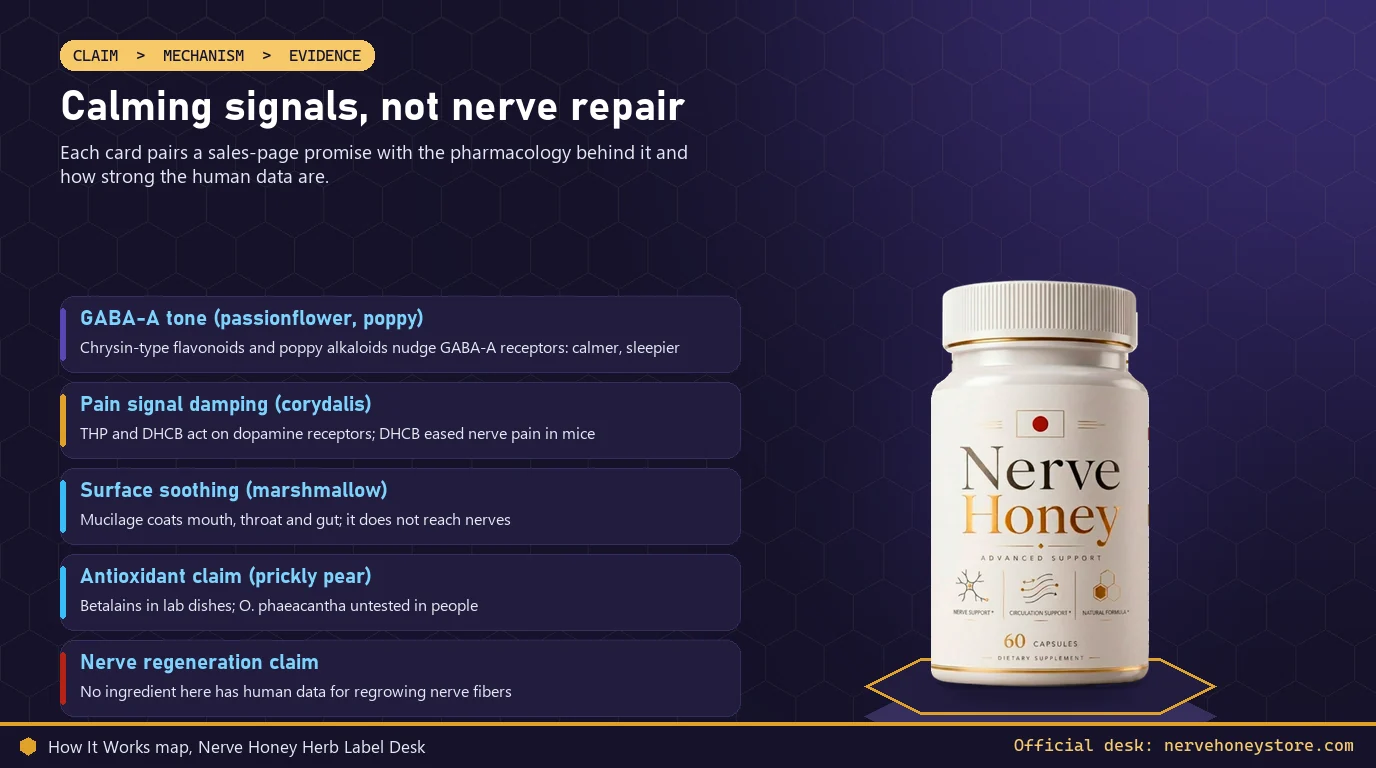
Pathway 1: GABA-A calming (passionflower, California poppy)
GABA is the brain's main "brake" chemical. Drugs that enhance its action at GABA-A receptors (benzodiazepines, sleeping pills) reduce anxiety and cause sleepiness. Passionflower flavonoids appear to act here, though the exact compounds and their absorption are still debated[6]. California poppy alkaloids modulate GABA-A receptors in laboratory tests[9], and its extracts sedate mice[10].
In people, passionflower has lengthened measured sleep time in insomnia[8]. In rats with chemically induced nerve injury, passionflower extract reduced pain behaviors through GABA and opioid pathways[7]. That rat result is the closest thing to nerve-pain evidence for any Nerve Honey herb, and it is an animal model, at extract doses far above a capsule.
What this pathway can plausibly do: help you feel calmer and fall asleep more easily, which can make night-time tingling less disruptive. What it cannot do: change the nerve damage itself.
Pathway 2: dopamine-linked pain damping (corydalis)
Corydalis alkaloids act on dopamine receptors in the brain and spinal cord. Dehydrocorybulbine reduced several kinds of pain in mice, including pain after nerve injury, largely through dopamine D2 receptors[11]. Tetrahydropalmatine blocks dopamine receptors and is sedating. Protopine, shared with California poppy, has anti-inflammatory and analgesic activity in laboratory studies[13].
In people, a corydalis and angelica combination raised tolerance to ice-water pain[12]. That is short, experimental pain in healthy volunteers. No trial has tested corydalis for neuropathy, and none has tested 100 mg of plain corydalis powder for anything.
What this pathway can plausibly do: add a little to sedation and perhaps dull pain perception slightly. What it cannot do: heal nerves; and because corydalis is pharmacologically active, it is also where the liver and interaction cautions come from.
Pathway 3: surface soothing and antioxidants (marshmallow, prickly pear)
Marshmallow root mucilage coats the throat and stomach, which is why European regulators accept it only for coughs and mild digestive discomfort[14]. Mucilage is not absorbed into the bloodstream in a way that could reach peripheral nerves.
Prickly pear contains betalain pigments and polyphenols with antioxidant activity in laboratory tests. Oxidative stress is part of diabetic nerve damage[2], so antioxidants are a reasonable research idea. But the only human prickly pear study cited for inflammation used a different species, for hangover[15], and the antioxidant with the most neuropathy evidence, alpha-lipoic acid at 600 mg a day intravenously or orally, is not in this formula[16].
Does the combination add up to more?
The sales page says the five herbs "work synergistically." Synergy is a testable claim: you would compare the combination with each herb alone, at the same doses, in the same people. That has not been done for this formula. What can be predicted from pharmacology is additive sedation, because three of the five herbs push in the same calming direction. That is useful to know for safety, and it is also probably the main thing a buyer will feel.
It is also worth knowing that the identical five herbs at identical milligrams are sold under other brand names. A stock formula is not a bad thing, but it does mean the "secret behind Nerve Honey" is a widely used contract-manufacturer blend rather than a proprietary discovery.
The sales page claims, checked one by one
| Seller claim | What the evidence supports |
|---|---|
| Eliminates nerve pain | No study of this product. Small animal signals for passionflower and corydalis. Supplements may not lawfully claim to treat disease. |
| Stops tingling | No human data for any of the five herbs on tingling or paresthesia. |
| Restores complete mobility and comfort | Not measured anywhere. Sedation can reduce mobility in some people. |
| Protects nerves from sticky toxins | No defined mechanism or study. The phrase has no scientific meaning we could trace. |
| Boosts blood circulation to damaged nerves | No human circulation data for these herbs at any dose. |
| Optimizes regeneration of nerve cells | No ingredient has human evidence for nerve regeneration. |
| Calms the nervous system, improves rest | Plausible: passionflower has small sleep and anxiety trials; poppy and corydalis are sedating. |
Statements like the first six are disease claims under federal rules, which a supplement label may not make[19]. The product's own footer disclaimer, that it is not intended to diagnose, treat, cure or prevent any disease, sits on the same page as those claims.
The seller's “Scientific References” block
Near the bottom of the sales page sits a heading reading "Scientific References." Under it are five logos, Harvard University, the National Center for Biotechnology Information, The Lancet Planetary Health, the National Institute of Mental Health and PubMed, followed by a line saying the company is not endorsed by, sponsored by or affiliated with any of them. There is no list of studies: no author, no title, no year, no link.
Logos are not references. A reference lets a reader find the exact study and check whether it tested the ingredient, at what dose, in whom and with what result. We did that work for each herb on the ingredients page, and the honest summary is that the studies exist for calm and sleep, not for nerves. A journal about planetary health and an institute for mental health have no obvious connection to a nerve-comfort capsule, which suggests the logo row was chosen for recognition rather than relevance.
Where Nerve Honey sits among the options for nerve symptoms
Putting the capsule next to the approaches that have been tested makes its role clearer. The table summarizes what the American Diabetes Association and the neuropathic pain literature support[1] [4]; for anything prescription, the decision belongs to your clinician.
| Approach | What it targets | Strength of evidence |
|---|---|---|
| Glucose control (diabetes) | Slowing the underlying damage | Strong for prevention and slowing; does not reverse damage |
| Daily foot checks, proper footwear | Preventing ulcers in numb feet | Strong; core of every guideline |
| Duloxetine, pregabalin, gabapentin | Painful symptoms | Moderate to strong in trials; side effects common |
| Tricyclics (e.g. amitriptyline) | Painful symptoms | Moderate; limited in older adults by side effects |
| Vitamin B12, if deficient | A reversible cause | Strong when deficiency is confirmed by blood test |
| Alpha-lipoic acid 600 mg | Symptoms (antioxidant) | Modest; mainly intravenous and short-term trials |
| Exercise and balance training | Function and falls | Moderate; also helps glucose |
| Nerve Honey (five herbs, 450 mg) | Evening calm, possibly sleep | None for nerve symptoms; small trials for passionflower calm and sleep |
Seen this way, Nerve Honey is not competing with the medicines; it is closer to a cup of passionflower tea in a capsule, plus four other plants at small doses. That can still be worth trying for some people, provided the tested measures in the rows above are already in place.
Better questions to ask about nerve symptoms
If you are considering Nerve Honey because of tingling or burning feet, these questions will usually do more good than any capsule:
- Has the cause been identified? Diabetes, B12 deficiency, thyroid disease, alcohol, kidney disease, chemotherapy and some medicines all produce the same symptoms[3].
- If you take metformin, has your B12 been checked? Long-term metformin use raises the risk of B12 deficiency, which can cause or worsen neuropathy[17].
- Is your glucose, or A1c, where your doctor wants it? Better control slows progression[5].
- Have your feet been examined this year? Loss of protective sensation is what leads to unnoticed wounds.
- Would a guideline medicine, physical therapy or a sleep plan help more? Discuss options with the clinician who knows your history[18].
None of this rules out trying Nerve Honey. It puts it in the right place: a gentle, unproven extra, not a substitute.
Questions on this topic
How does Nerve Honey work, in one sentence?
Three of its five herbs are calming and mildly sedating, which may make nerve symptoms less bothersome at night; none of the five repairs nerves.
Does Nerve Honey regenerate nerves?
No evidence says so. No ingredient in the formula has human data for nerve regeneration, and no supplement has been shown to reverse established neuropathy.
Does Nerve Honey improve circulation?
Not in any measured way. The circulation claim rests on a prickly pear species that has never been tested in people.
How fast would any effect appear?
Calming effects, if any, usually show within days. If nothing has changed by week six, the formula is unlikely to help you.
Is it like gabapentin or pregabalin?
Only loosely, in that both calm nerve activity. The prescription drugs have trial evidence for neuropathic pain; these herbs do not.
Could Nerve Honey help sciatica or restless legs?
Nothing in the research addresses either. Sciatica is a compressed nerve root and restless legs syndrome has its own causes, including low iron; both deserve a proper diagnosis. A sedating herb may make evenings easier, but it does not treat the cause.
Why does the seller list logos instead of studies?
We cannot say why, but a row of institution logos lets a reader check nothing. Real references name the authors, the journal and the year, so anyone can see what was tested and on whom.
Sources behind this page
Every link opens the original record. Those studies used single herbs at their own doses, often as extracts or teas, and none of them gave anyone a Nerve Honey capsule.
- 1Pop-Busui R, Boulton AJ, Feldman EL, et al. Diabetic neuropathy: a position statement by the American Diabetes Association. Diabetes Care. 2017;40(1):136-154. pubmed.ncbi.nlm.nih.gov/27999003/
- 2Feldman EL, Callaghan BC, Pop-Busui R, et al. Diabetic neuropathy. Nat Rev Dis Primers. 2019;5(1):41. pubmed.ncbi.nlm.nih.gov/31197153/
- 3National Institute of Neurological Disorders and Stroke. Peripheral Neuropathy. www.ninds.nih.gov/health-information/disorders/peripheral-neuropathy
- 4Finnerup NB, Attal N, Haroutounian S, et al. Pharmacotherapy for neuropathic pain in adults: a systematic review and meta-analysis. Lancet Neurol. 2015;14(2):162-173. pubmed.ncbi.nlm.nih.gov/25575710/
- 5American Diabetes Association Professional Practice Committee. 12. Retinopathy, neuropathy, and foot care: Standards of Care in Diabetes-2025. Diabetes Care. 2025;48(Suppl 1):S252-S265. pubmed.ncbi.nlm.nih.gov/39651973/
- 6Miroddi M, Calapai G, Navarra M, Minciullo PL, Gangemi S. Passiflora incarnata L.: ethnopharmacology, clinical application, safety and evaluation of clinical trials. J Ethnopharmacol. 2013;150(3):791-804. pubmed.ncbi.nlm.nih.gov/24140586/
- 7Aman U, Subhan F, Shahid M, et al. Passiflora incarnata attenuation of neuropathic allodynia and vulvodynia apropos GABA-ergic and opioidergic antinociceptive and behavioural mechanisms. BMC Complement Altern Med. 2016;16:77. pubmed.ncbi.nlm.nih.gov/26912265/
- 8Lee J, Jung HY, Lee SI, Choi JH, Kim SG. Effects of Passiflora incarnata Linnaeus on polysomnographic sleep parameters in subjects with insomnia disorder: a double-blind randomized placebo-controlled study. Int Clin Psychopharmacol. 2020;35(1):29-35. pubmed.ncbi.nlm.nih.gov/31714321/
- 9Fedurco M, Gregorová J, Šebrlová K, et al. Modulatory effects of Eschscholzia californica alkaloids on recombinant GABAA receptors. Biochem Res Int. 2015;2015:617620. pubmed.ncbi.nlm.nih.gov/26509084/
- 10Rolland A, Fleurentin J, Lanhers MC, et al. Behavioural effects of the American traditional plant Eschscholzia californica: sedative and anxiolytic properties. Planta Med. 1991;57(3):212-216. pubmed.ncbi.nlm.nih.gov/1680240/
- 11Zhang Y, Wang C, Wang L, et al. A novel analgesic isolated from a traditional Chinese medicine. Curr Biol. 2014;24(2):117-123. pubmed.ncbi.nlm.nih.gov/24388848/
- 12Yuan CS, Mehendale SR, Wang CZ, et al. Effects of Corydalis yanhusuo and Angelicae dahuricae on cold pressor-induced pain in humans: a controlled trial. J Clin Pharmacol. 2004;44(11):1323-1327. pubmed.ncbi.nlm.nih.gov/15496650/
- 13Huang W, Kong L, Cao Y, Yan L. Identification and quantification, metabolism and pharmacokinetics, pharmacological activities, and botanical preparations of protopine: a review. Molecules. 2021;27(1). pubmed.ncbi.nlm.nih.gov/35011447/
- 14European Medicines Agency, Committee on Herbal Medicinal Products. Althaeae radix (marshmallow root): herbal medicine overview and monograph. www.ema.europa.eu/en/medicines/herbal/althaeae-radix
- 15Wiese J, McPherson S, Odden MC, Shlipak MG. Effect of Opuntia ficus indica on symptoms of the alcohol hangover. Arch Intern Med. 2004;164(12):1334-1340. pubmed.ncbi.nlm.nih.gov/15226168/
- 16Ziegler D, Nowak H, Kempler P, Vargha P, Low PA. Treatment of symptomatic diabetic polyneuropathy with the antioxidant alpha-lipoic acid: a meta-analysis. Diabet Med. 2004;21(2):114-121. pubmed.ncbi.nlm.nih.gov/14984445/
- 17Aroda VR, Edelstein SL, Goldberg RB, et al. Long-term metformin use and vitamin B12 deficiency in the Diabetes Prevention Program Outcomes Study. J Clin Endocrinol Metab. 2016;101(4):1754-1761. pubmed.ncbi.nlm.nih.gov/26900641/
- 18National Center for Complementary and Integrative Health. Using Dietary Supplements Wisely. www.nccih.nih.gov/health/using-dietary-supplements-wisely
- 19Electronic Code of Federal Regulations. 21 CFR 101.93: Certain types of statements for dietary supplements. www.ecfr.gov/current/title-21/chapter-I/subchapter-B/part-101/subpart-F/section-101.93
Treat Nerve Honey as a 60-day experiment you can measure
Checkout happens on the seller's BuyGoods page, not here. Before the first dose, run the label past your pharmacist if you use sleep aids, pain medicine or anything for mood; write down a 0 to 10 score for tingling, burning and sleep; keep the order email and the packing slip; and settle by day 45 whether the bottles go back to Florida while the window is still open.