
Nerve Honey Ingredients: Five Botanicals, Their Milligrams and the Research Behind Each
Every line of the Nerve Honey label, largest first, with what the seller claims and what human studies actually tested.
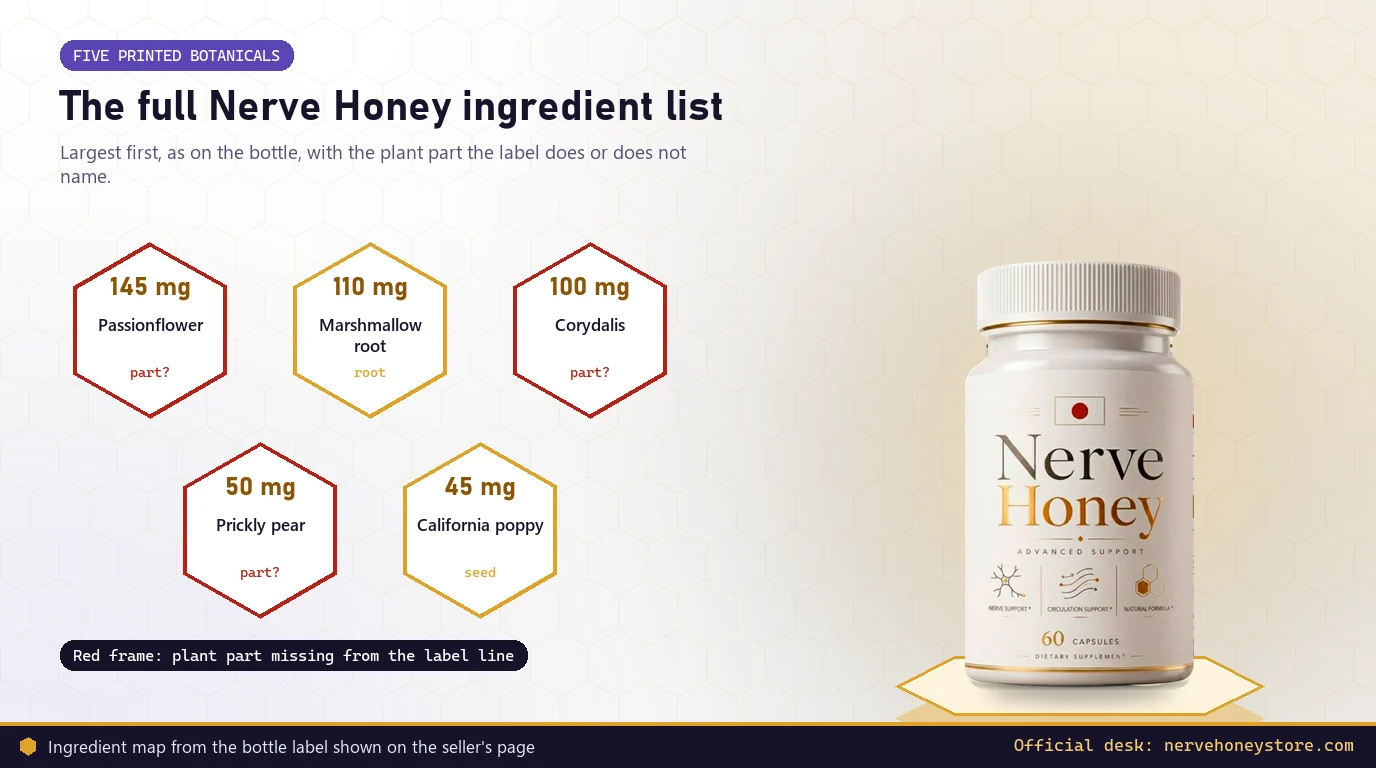
Five herbs, ranked by weight
Nerve Honey has one of the shortest labels in the nerve-supplement aisle: five botanicals, each with its own milligram figure, adding up to 450 mg in a two-capsule serving. There is no proprietary blend hiding the split. This page takes them in label order, largest first, and for each one sets out three things: what the plant is, what the seller claims for it, and what human research actually measured. Where the research used a different plant part, a different species or a far larger dose, we say so plainly.
A word on reading the table below. "Research dose" means the amount given in the closest human study we could find, not a recommended amount. "Evidence for nerve symptoms" refers specifically to peripheral neuropathy, tingling, burning or numbness, the problems the product is marketed for. For all five herbs that column is empty, and we think a buyer should know that before reading the details.
| Label line | mg per serving | Plant part on label | Closest human research | Evidence for nerve symptoms |
|---|---|---|---|---|
| Passionflower (Passiflora incarnata) | 145 | not stated | Anxiety, sleep, pre-surgery calm | None |
| Marshmallow (Althaea officinalis) root | 110 | root | Throat and stomach (traditional use) | None |
| Corydalis (Corydalis yanhusuo) powder | 100 | not stated | Cold-water pain test with angelica | None |
| Prickly pear (Opuntia phaeacantha) 20:1 extract | 50 | not stated | Different species, hangover markers | None |
| California poppy (Eschscholzia californica) seed | 45 | seed | Aerial herb in a combination for anxiety | None |
Passionflower, 145 mg
The plant
Passiflora incarnata, the purple maypop vine native to the southeastern United States, is the most researched calming herb in the formula. Herbal medicine uses the flowering aerial parts: leaves, stems and flowers. Its active compounds are thought to be flavonoids such as vitexin, isovitexin and chrysin, with possible action at GABA-A receptors, the same family of receptors that benzodiazepines act on, but with a much milder effect[1].
What the seller says
The sales page credits passionflower with "gently reducing the hyperactivity of neural connections," easing tension in the limbs and improving night-time rest. The sleep and tension part matches the research reasonably well. The suggestion that it calms overactive nerves in the limbs does not; no study measured limb nerves.
What the research measured
The human trials are small but real. In generalized anxiety disorder, 45 drops a day of passionflower extract performed about as well as the benzodiazepine oxazepam over four weeks, with less impairment of job performance[3]. A week of nightly passionflower tea improved self-rated sleep quality compared with a placebo tea[4], and a two-week trial with an extract increased total sleep time measured by polysomnography in people with insomnia[5]. Single doses of 500 mg before ambulatory surgery and 260 mg before dental extraction lowered pre-procedure anxiety[6] [7]. A 2020 systematic review called the anxiety and sleep evidence promising but limited by trial size[2].
How the label dose compares
Nerve Honey does not say whether its 145 mg is raw herb powder or an extract. If it is powder, it delivers less active material than a single strong cup of passionflower tea. If it is a concentrated extract, it sits below, but within reach of, the pre-procedure doses. Either way it was not tested for nerve pain.
Safety notes
NCCIH lists drowsiness, dizziness and confusion as possible side effects, advises against use in pregnancy because of possible uterine contractions, and warns about combining it with anesthesia[8]. The European monograph restricts it to adults and adolescents over 12[9].
Marshmallow root, 110 mg
The plant
Althaea officinalis is a pink-flowered mallow of wet European meadows; its root once gave the confection its name. The root is about one-tenth mucilage, a slippery mix of polysaccharides that swells in water and coats mucous membranes.
What the seller says
The sales page calls it "a protective biological shield" that reduces hypersensitivity to touch in the extremities. We found no source for this idea. The mucilage works where it touches: the mouth, throat and stomach lining. It is not absorbed in a form that could reach nerves in the feet.
What the research measured
The European Medicines Agency's herbal committee recognizes marshmallow root only on the basis of long traditional use, for irritation of the mouth or throat with dry cough and for mild stomach and gut discomfort[10]. There are no controlled trials for nerve symptoms, and the traditional preparations use grams of root soaked in cold water, many times the 110 mg here. The lactation database notes it is generally regarded as low-risk but without good safety data in nursing[11].
Practical note
Because mucilage can slow the absorption of other medicines swallowed at the same moment, it is sensible to take Nerve Honey an hour apart from other pills. At 110 mg the effect is probably small, but the habit costs nothing.
Corydalis, 100 mg
The plant
Corydalis yanhusuo is a small spring-flowering plant whose tuber, yan hu suo, has been a pain remedy in Chinese medicine for centuries. It is the most pharmacologically active ingredient in Nerve Honey, and the one that deserves the most respect.
What the seller says
"A powerful relief agent that intercepts discomfort signals before they can reach your brain." That is an ambitious summary of real but early research.
What the research measured
Corydalis contains more than a dozen isoquinoline alkaloids. The best known are tetrahydropalmatine (THP), which blocks dopamine receptors and is sedating, and dehydrocorybulbine (DHCB). In 2014, researchers showed that DHCB reduced inflammatory pain and nerve-injury pain in mice, acting largely through dopamine D2 receptors, and without the tolerance that develops with morphine[12]. A later rodent study tied DHCB to reduced nerve pain after spinal cord injury[13]. Corydalis also contains protopine, an alkaloid shared with California poppy[17].
Human data are thin. A controlled laboratory study gave volunteers a corydalis and angelica preparation and found it raised tolerance to the pain of holding a hand in ice water[14]. That is acute experimental pain, not neuropathy, and the dose was a combination product.
How the label dose compares
Traditional Chinese decoctions use roughly 3 to 10 grams of the dried tuber. Nerve Honey's 100 mg of powder is about 1 to 3% of that range, and the label does not say whether it is standardized for any alkaloid.
Safety notes
THP was the active compound in Jin Bu Huan, a Chinese herbal product linked in the 1990s to acute hepatitis in adults and to slowed breathing and heart rate in children who swallowed it accidentally[15]. A 2025 study set out evidence that corydalis itself can cause idiosyncratic liver injury, the unpredictable kind that affects a few susceptible people[16]. At 100 mg the risk is likely low, but anyone with liver disease, or who notices dark urine, yellowing eyes or right-sided belly pain, should stop and see a doctor.
Prickly pear 20:1 extract, 50 mg
The plant
The label names Opuntia phaeacantha, the desert or tulip prickly pear of the American Southwest, a wild species. The prickly pear in most research and most grocery stores is a different species, Opuntia ficus-indica. "20:1" means 20 parts of plant made 1 part of extract, so 50 mg came from about 1 gram of plant. The label does not say whether that was fruit, pad (nopal) or flower.
What the seller says
Improved peripheral circulation and relief of numbness through better delivery of oxygen and nutrients. We found no human study of circulation or numbness with any prickly pear.
What the research measured
For O. ficus-indica, a fruit-skin extract taken before drinking reduced some hangover symptoms and lowered C-reactive protein, an inflammation marker, in a small crossover trial[18]. For O. phaeacantha, published work is food science: one study described the color, antioxidant content and proteins of its wild fruit[19]. There is no human clinical study of this species for any health outcome.
Practical note
Prickly pear pads (nopal) can lower blood sugar after meals in people with diabetes, though that research used whole pads at food-level amounts. A 50 mg fruit or pad extract is unlikely to matter, but if you use insulin and see unexpected lows, mention it to your doctor.
California poppy seed, 45 mg
The plant
Eschscholzia californica, the orange state flower of California, has been used as a mild sedative by Native Californians and in European herbalism. It belongs to the poppy family but contains no morphine or codeine; its alkaloids include californidine, escholtzine and protopine.
What the seller says
Relaxes muscles and nerve pathways, calms spasms and prepares the body for restorative rest.
What the research measured
In mice, extracts of the aerial parts were sedative and reduced anxiety-like behavior[20], and further work described effects on sleep-related brain activity[21]. Laboratory tests show several of its alkaloids modulate GABA-A receptors[22]. The main human trial gave people with mild to moderate anxiety a tablet combining California poppy extract, hawthorn and magnesium, twice a day for three months, and found modest improvement over placebo[23]. The poppy's own contribution cannot be isolated from that design.
The seed question
Every study above used the flowering plant. Nerve Honey's label specifies seed. Seeds of many poppy-family plants carry a different, usually lower, alkaloid profile than the leaves and flowers. We found no research on California poppy seed as a sedative or pain remedy, at 45 mg or any dose, so this line has no benchmark at all.
The other ingredients
Three non-herbal materials make up the rest of each capsule. Hydroxypropyl methylcellulose (hypromellose) is the vegetable capsule shell. Magnesium stearate is a flow agent that keeps powder from sticking to machinery; the amount is trivial. Microcrystalline cellulose is a purified wood-pulp filler that bulks out the powder so each capsule is the same size.
Each capsule holds 225 mg of herbs. A standard size "0" vegetable capsule holds roughly 400 to 500 mg of powder, so a meaningful part of each capsule is probably cellulose. That is normal manufacturing practice. What is not normal is the sales page listing microcrystalline cellulose as one of six featured "elements" with a paragraph about keeping molecules balanced and potency stable. It is an inactive filler.
What the label rule expects, and where Nerve Honey falls short
U.S. regulations require a dietary supplement label to identify each botanical by common or usual name, and to state the part of the plant from which it is derived[24]. Marshmallow (root) and California poppy (seed) meet this. Passionflower, corydalis and prickly pear do not name a part. For corydalis the missing word is a small omission, since the tuber is the only part used medicinally. For passionflower and prickly pear it leaves genuine uncertainty about what is in the capsule.
Ask the support desk which plant parts were used and whether passionflower and corydalis are powders or extracts. A seller that knows its supply chain can answer in a sentence.
Questions on this topic
Which Nerve Honey ingredient is most likely to have an effect?
Passionflower, for calm and sleep, because it has the most human trials. Corydalis is the most pharmacologically potent but has very little human data and a liver-safety caveat.
Does Nerve Honey contain any vitamins such as B12 or B1?
No. The label lists only five herbs. If you have neuropathy and take metformin, ask your doctor about a vitamin B12 blood test; that is a deficiency a supplement of herbs will not fix.
Is California poppy an opiate?
No. It is in the poppy family but contains no morphine, codeine or other opiates. Its alkaloids act mainly on GABA receptors and are mildly sedating.
Why does the plant part matter?
Different parts of one plant contain different compounds at different strengths. Studies on poppy flowers or passionflower leaves say little about seeds or unknown parts.
Is there honey in the capsules?
No. Honey is not listed among the active or other ingredients.
Sources behind this page
Every link opens the original record. Those studies used single herbs at their own doses, often as extracts or teas, and none of them gave anyone a Nerve Honey capsule.
- 1Miroddi M, Calapai G, Navarra M, Minciullo PL, Gangemi S. Passiflora incarnata L.: ethnopharmacology, clinical application, safety and evaluation of clinical trials. J Ethnopharmacol. 2013;150(3):791-804. pubmed.ncbi.nlm.nih.gov/24140586/
- 2Janda K, Wojtkowska K, Jakubczyk K, Antoniewicz J, Skonieczna-Żydecka K. Passiflora incarnata in neuropsychiatric disorders: a systematic review. Nutrients. 2020;12(12):3894. pubmed.ncbi.nlm.nih.gov/33352740/
- 3Akhondzadeh S, Naghavi HR, Vazirian M, Shayeganpour A, Rashidi H, Khani M. Passionflower in the treatment of generalized anxiety: a pilot double-blind randomized controlled trial with oxazepam. J Clin Pharm Ther. 2001;26(5):363-367. pubmed.ncbi.nlm.nih.gov/11679026/
- 4Ngan A, Conduit R. A double-blind, placebo-controlled investigation of the effects of Passiflora incarnata (passionflower) herbal tea on subjective sleep quality. Phytother Res. 2011;25(8):1153-1159. pubmed.ncbi.nlm.nih.gov/21294203/
- 5Lee J, Jung HY, Lee SI, Choi JH, Kim SG. Effects of Passiflora incarnata Linnaeus on polysomnographic sleep parameters in subjects with insomnia disorder: a double-blind randomized placebo-controlled study. Int Clin Psychopharmacol. 2020;35(1):29-35. pubmed.ncbi.nlm.nih.gov/31714321/
- 6Movafegh A, Alizadeh R, Hajimohamadi F, Esfehani F, Nejatfar M. Preoperative oral Passiflora incarnata reduces anxiety in ambulatory surgery patients: a double-blind, placebo-controlled study. Anesth Analg. 2008;106(6):1728-1732. pubmed.ncbi.nlm.nih.gov/18499602/
- 7Dantas LP, de Oliveira-Ribeiro A, de Almeida-Souza LM, Groppo FC. Effects of Passiflora incarnata and midazolam for control of anxiety in patients undergoing dental extraction. Med Oral Patol Oral Cir Bucal. 2017;22(1):e95-e101. pubmed.ncbi.nlm.nih.gov/27918731/
- 8National Center for Complementary and Integrative Health. Passionflower. www.nccih.nih.gov/health/passionflower
- 9European Medicines Agency, Committee on Herbal Medicinal Products. Passiflorae herba (passion flower): herbal medicine overview and monograph. www.ema.europa.eu/en/medicines/herbal/passiflorae-herba
- 10European Medicines Agency, Committee on Herbal Medicinal Products. Althaeae radix (marshmallow root): herbal medicine overview and monograph. www.ema.europa.eu/en/medicines/herbal/althaeae-radix
- 11Drugs and Lactation Database (LactMed). Marshmallow. Bethesda (MD): National Library of Medicine; 2006-. pubmed.ncbi.nlm.nih.gov/30000899/
- 12Zhang Y, Wang C, Wang L, et al. A novel analgesic isolated from a traditional Chinese medicine. Curr Biol. 2014;24(2):117-123. pubmed.ncbi.nlm.nih.gov/24388848/
- 13Wang Z, et al. Role of dehydrocorybulbine in neuropathic pain after spinal cord injury mediated by P2X4 receptor. Mol Cells. 2019. pubmed.ncbi.nlm.nih.gov/30622226/
- 14Yuan CS, Mehendale SR, Wang CZ, et al. Effects of Corydalis yanhusuo and Angelicae dahuricae on cold pressor-induced pain in humans: a controlled trial. J Clin Pharmacol. 2004;44(11):1323-1327. pubmed.ncbi.nlm.nih.gov/15496650/
- 15Horowitz RS, Feldhaus K, Dart RC, Stermitz FR, Beck JJ. The clinical spectrum of Jin Bu Huan toxicity. Arch Intern Med. 1996;156(8):899-903. pubmed.ncbi.nlm.nih.gov/8774209/
- 16Guo L, Lin L, Ling J, et al. A new discovery: Corydalis yanhusuo causes idiosyncratic hepatotoxicity and its potential mechanisms. Biomed Chromatogr. 2025;39:e70093. pubmed.ncbi.nlm.nih.gov/40277353/
- 17Huang W, Kong L, Cao Y, Yan L. Identification and quantification, metabolism and pharmacokinetics, pharmacological activities, and botanical preparations of protopine: a review. Molecules. 2021;27(1). pubmed.ncbi.nlm.nih.gov/35011447/
- 18Wiese J, McPherson S, Odden MC, Shlipak MG. Effect of Opuntia ficus indica on symptoms of the alcohol hangover. Arch Intern Med. 2004;164(12):1334-1340. pubmed.ncbi.nlm.nih.gov/15226168/
- 19Valero-Galván J, González-Fernández R, Sigala-Hernández A, et al. Sensory attributes, physicochemical and antioxidant characteristics, and protein profile of wild prickly pear fruits (O. macrocentra, O. phaeacantha, O. engelmannii) and commercial prickly pear fruits (O. ficus-indica). Food Res Int. 2021;140:109909. pubmed.ncbi.nlm.nih.gov/33648207/
- 20Rolland A, Fleurentin J, Lanhers MC, et al. Behavioural effects of the American traditional plant Eschscholzia californica: sedative and anxiolytic properties. Planta Med. 1991;57(3):212-216. pubmed.ncbi.nlm.nih.gov/1680240/
- 21Rolland A, Fleurentin J, Lanhers MC, Misslin R, Mortier F. Neurophysiological effects of an extract of Eschscholzia californica Cham. (Papaveraceae). Phytother Res. 2001;15(5):377-381. pubmed.ncbi.nlm.nih.gov/11507727/
- 22Fedurco M, Gregorová J, Šebrlová K, et al. Modulatory effects of Eschscholzia californica alkaloids on recombinant GABAA receptors. Biochem Res Int. 2015;2015:617620. pubmed.ncbi.nlm.nih.gov/26509084/
- 23Hanus M, Lafon J, Mathieu M. Double-blind, randomised, placebo-controlled study to evaluate the efficacy and safety of a fixed combination containing two plant extracts (Crataegus oxyacantha and Eschscholtzia californica) and magnesium in mild-to-moderate anxiety disorders. Curr Med Res Opin. 2004;20(1):63-71. pubmed.ncbi.nlm.nih.gov/14741074/
- 24Electronic Code of Federal Regulations. 21 CFR 101.36: Nutrition labeling of dietary supplements. www.ecfr.gov/current/title-21/chapter-I/subchapter-B/part-101/subpart-C/section-101.36
Treat Nerve Honey as a 60-day experiment you can measure
Checkout happens on the seller's BuyGoods page, not here. Before the first dose, run the label past your pharmacist if you use sleep aids, pain medicine or anything for mood; write down a 0 to 10 score for tingling, burning and sleep; keep the order email and the packing slip; and settle by day 45 whether the bottles go back to Florida while the window is still open.